IEER | Carbon-Free and Nuclear-Free main page

For further information: Bob Schaeffer (239) 395-6773

For use after 10:30am, Thurs, Dec. 20, 2007 teleconference

Summary in Slides [1.7MB PDF]

P R E S S    R E L E A S E

New Book Shows U.S. Carbon Dioxide Emissions Can be Completely Eliminated by 2050

A Roadmap for U.S. Global Climate Change Leadership after Bali Conference

Nuclear Power Is Not Needed for an Economical and Reliable Energy System without Fossil Fuels


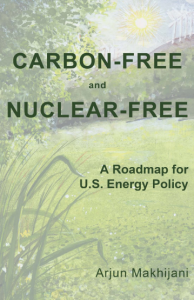
The United States can become a global leader against climate change by phasing out nearly all carbon dioxide emissions by the year 2050, according to a newly published book. Carbon-Free and Nuclear-Free: A Roadmap for U.S. Energy Policy demonstrates how the U.S. can eliminate the use of fossil fuels without sacrificing economic growth or building more nuclear power plants.

"As the recent Bali conference indicates, the world is looking to the U.S. for leadership, which has not been forthcoming so far," said Dr. Arjun Makhijani, the book's author. "This book is a roadmap for transforming the debate about global warming from political rhetoric to practical policies that can be implemented immediately. Making a zero-CO2 emissions' commitment is the way the U.S. can bring India and China into a serious dialog. Nearly complete elimination of CO2 emissions by 2050 is also implied by U.S. treaty commitments under the United Nations Framework Convention on Climate Change."

Dr. Makhijani holds a Ph.D. from the Electrical Engineering Department of the University of California at Berkeley, where he specialized in nuclear fusion. He is president of the Institute for Energy and Environmental Research in Takoma Park, Maryland. He was elected a Fellow of the American Physical Society in November 2007 for his "outstanding contributions to physics" and specifically for "his tireless efforts to provide the public with accurate and understandable information on energy and environmental issues."

Among the book's recommendations:

  • Enact a physical limit on carbon dioxide emissions (a "hard cap") for large users of fossil fuels that steadily declines to zero;
  • Eliminate all subsidies and tax breaks for fossil fuels, nuclear power and biofuels from food crops;
  • Build demonstration energy supply plants including solar thermal, solar photovoltaic, and carbon dioxide capture in microalgae for liquid fuel production;
  • Leverage government purchasing power to create markets for advanced technologies such as plug-in hybrid vehicles
  • Ban new coal-fired plants unless they include reliable carbon capture and storage
  • Create and enforce stringent efficiency standards for appliances, transportation and buildings

"These approaches are all technologically feasible, economically viable and environmentally benign," Dr. Makhijani explained. "Nuclear power, on the other hand, entails risks of proliferation, terrorism and serious accidents."

The analysis in Carbon-Free and Nuclear-Free shows that a reliable electricity grid can be created entirely from renewable energy sources, despite the intermittency of wind and solar energy. "First of all, wind and solar development should be coordinated, since wind often predominates at night and solar, is, by definition, in the daytime," said Dr. Makhijani. "Then, hydropower resources can be used when neither is available, complemented by natural gas standby."

In the long term, some baseload capacity would be created using biomass and geothermal resources, solar thermal power plants with heat storage, complemented by electricity storage technologies, according to the Roadmap. Natural gas standby capacity can be replaced by bio-methane standby. The book presents the first schematic of a reliable electricity grid based entirely on renewable energy sources.

"A distributed grid will actually be more reliable and less vulnerable to terrorism and large-scale black-outs than the centralized grid we have today," Dr. Makhijani claimed. "And if we focus solar energy development on commercial parking lots and rooftops, the problem of transmission corridors will be much reduced."

Carbon-Free and Nuclear-Free has already been embraced by a wide variety of energy and environmental experts. In a foreword to the book, S. David Freeman, former Chairman of the Tennessee Valley Authority, writes, "This Roadmap could liberate us from an energy policy that is trashing our climate and our mountain tops, that is polluting our land, sea, and air, that is trying to resurrect dangerous nuclear power, and that has America so dependent on imported oil that our foreign policy is the prisoner of oil. It shines a light on the path to a renewable energy economy." The president of Friends of the Earth, Brent Blackwelder, the most senior environmental lobbyist in Washington, also endorsed the book's agenda.

The initial, overwhelmingly positive reaction to the Roadmap, which cuts across conventional lines of partisanship and ideology, has resulted in initial planning for a national campaign to implement its recommendations. A kick-off conference is planned for spring, 2008.

Carbon-Free and Nuclear-Free is published by RDR Books and IEER Press. The book was the result of a joint project of Institute for Energy and Environmental Research and the Nuclear Policy Research Institute.. Review copies are available on request. The text is also posted on the web at http://www.ieer.org/carbonfree/CarbonFreeNuclearFree.pdf and can be downloaded free. [PDF 4.4MB]

--30--

Summary in Slides [1.7MB PDF]

Book also available in paperback.

Also available:
Executive summary [PDF 460kB]
Executive Summary in Science for Democratic Action [PDF 2.5MB]
Press release, July 30, 2007


Related materials on this site:
  • Insurmountable Risks: The Dangers of Using Nuclear Power to Combat Global Climate Change (IEER Press and RDR Books, 2006)
  • Our Electric Future: A Non-Nuclear Low Carb Diet? Interview with Arjun Makhijani in the Fall 2005 New Hampshire Sierran
  • Uranium Enrichment: Facts to Fuel an Informed Debate on Nuclear Proliferation and Nuclear Power, article in Science for Democratic Action, March 2005
  • Atomic Myths, Radioactive Realities: Why Nuclear Power Is a Poor Way to Meet Energy Needs (Journal of Land, Resources, & Environmental Law, 2004)
  • List of selected IEER materials on energy issues

    Available at EggheadBooks:

  • The Nuclear Power Deception: U.S. Nuclear Mythology from Electricity "Too Cheap to Meter" to "Inherently Safe" Reactors (Apex Press, 1999)
    Institute for Energy and Environmental Research
    Comments to info[at]ieer.org
    Takoma Park, Maryland, USA

    December 20, 2007
    Updated March 12, 2008